
The Department of Adult Cardiac Surgery at the Timone Hospital, led by Professor Frédéric COLLART, has set up a Mobile Circulatory Support Unit (UMAC). With the help of SAMU 13 and Civil Security, a team mobilized 24 hours a day can directly intervene in emergency with a patient in cardiac or respiratory distress.
In the heart of UMAC
The mobile unit is able to move urgently to any hospital or clinic in Provence or Corsica, and to provide a temporary circulatory or respiratory assistance to patients with bad chances of survival.
These patients, often young, may be struck by heart attack, myocarditis (acute inflammation of the heart), or acute respiratory distress. The severity of their condition makes it impossible to transfer them.
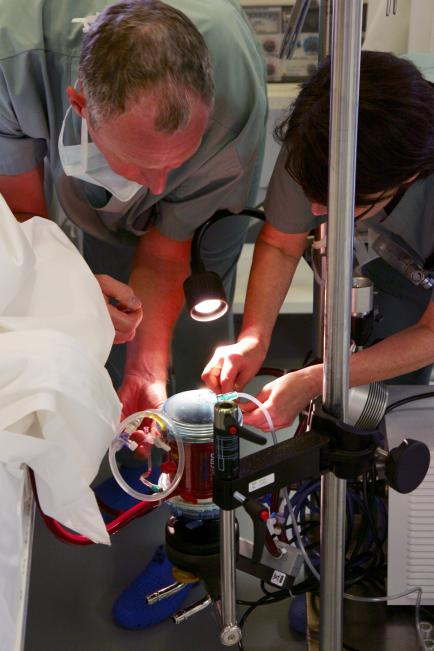
The UMAC team moves up to the patient's bedside to set up a temporary artificial heart: every minute is precious.
A highly specialized team
The 24-hour team is composed of :
- a cardiac surgeon,
- a medical resuscitator,
- a perfusionist nurse (specialist nurse in extracorporeal circulation),
- a nurse.
The close collaboration with the SAMU (emergency medical services) allows a very fast mobilization for a helicopter or vehicle transportation.
The UMAC intervenes within the whole Provence – Alpes – Côte d’Azur and Corse area, in record time.
Response time from the call received by the team to the start-up of the cardiac support system is very short :
- 20 minutes for a patient hospitalized on the spot in La Timone,
- 30 to 45 minutes for a person in an outdoor resuscitation unit.
The Timone, pioneer of the artificial heart
The AP-HM Department of Adult Cardiac Surgery, at the instigation of Professor MONTIES, has been implanting artificial hearts for 20 years.
These artificial hearts are implanted in patients waiting for heart transplantation: more than 150 patients to this day. These increasingly smaller implantable devices have allowed a large number of patients to go back home awaiting for transplantation. The evolution, autonomy and long-term reliability of these devices make it possible to implant them permanently in patients who cannot be transplanted.
In some cases, the severity of patients' condition requires to place a temporary artificial heart before considering implantable artificial heart implantation or emergency transplantation.
Once on the spot, the surgeon installs the extracorporeal circulation devices (powerful oxygenators, percutaneous cannulas) in order to resuscitate the patient. This device can fully replace heart and lungs, and can work for several days or even weeks.
A tube, put in a vein at groin level, goes up to the entrance of the stopped heart. It sucks the blood which is oxygenated by a small membrane and then reinjected into the body through an artery. Circulatory assistance can be set up in a few minutes.
When his condition is stabilized, the patient is repatriated to Timone or North Hospital (in case of respiratory failure). The heart and lungs at rest may sometimes regenerate by themselves, otherwise a definitive device is scheduled: transplant or long-lasting artificial heart.
The AP-HM device is the first in France to benefit from logistics allowing it to intervene in all resuscitation Units of hospitals and clinics in the PACA Corse area.
 Some figures: 30 heart transplants per year - 45 pulmonary grafts per year at the North Hospital - 150 artificial hearts implantable for 20 years - 140 emergency pumps laid every year - 300 patients taken in charge by the UMAC